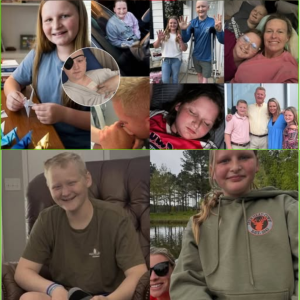
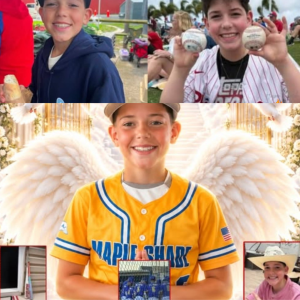
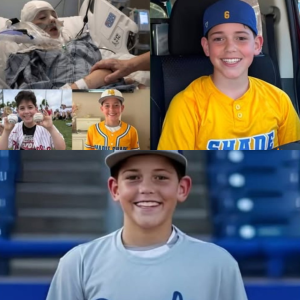
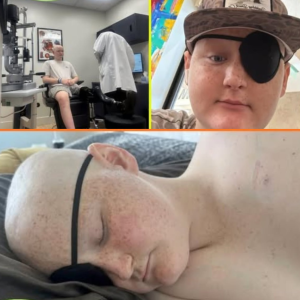
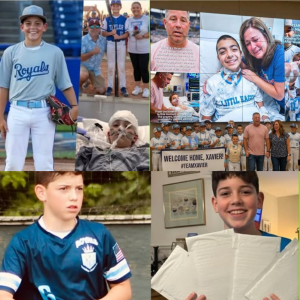
Brayden Auten was only eight years old, and until then, his life looked much like that of many other children his age. He was active, healthy, full of energy, and deeply passionate about wrestling, a sport he approached with enthusiasm and determination. No one in his family could have imagined that shortly after competing in a state championship, everything that had seemed normal would begin to disappear with terrifying speed.
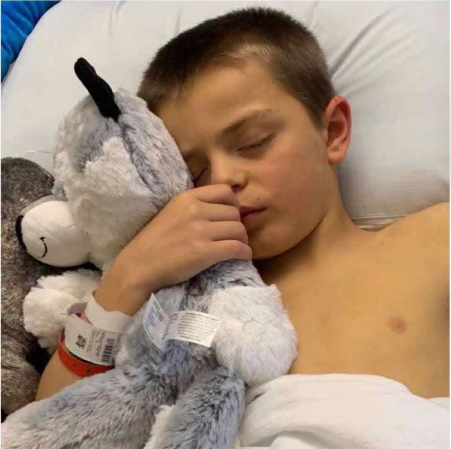
At first, Brayden simply began to feel very sick. His parents, Ruth and James, quickly realized that this did not look like an ordinary illness and took him to the hospital in search of answers. What they heard next immediately transformed a family concern into a desperate race against time.
Doctors discovered that an aggressive virus was severely damaging Brayden’s liver. His condition was so serious that he urgently needed a liver transplant to have a chance of surviving. Suddenly, his family was no longer thinking about wrestling tournaments, school, or ordinary childhood activities; they were thinking only about finding a compatible donor before it was too late.
For parents, few experiences can be more agonizing than being told that their child’s life depends on something they cannot simply provide through love or determination. Ruth and James could stay by Brayden’s side, ask questions, comfort him, and wait, but they could not create the organ he desperately needed. The solution had to come from another person, and every passing day made that waiting more frightening.
The family began urgently searching for a donor. According to reports, as many as 15 relatives were tested in the hope that one of them might be compatible and become the answer everyone was praying for. But one by one, those possibilities disappeared.
None of them were a match.
For Brayden’s family, every negative result must have felt like another door closing. It did not mean they had stopped hoping, but it meant time continued moving while their little boy still desperately needed a transplant. At that moment, the person who would eventually change Brayden’s story had not even entered their lives.
Her name was Camie Loritz.
Camie worked as an intensive care nurse at a nearby hospital. Through her profession, she understood better than most how fragile life can be, what families endure while waiting beside hospital beds, and how one medical intervention at the right time can completely change an outcome. But Brayden was not one of her patients.
Camie was not a friend of Ruth or James. She was not related to the family, had never shared a holiday with them, and had never even met the little boy whose life was now in danger. In every meaningful sense, she was a complete stranger.
Then she heard Brayden’s story.
She learned that an eight-year-old boy was critically ill, urgently needed a liver transplant, and that his family had still not found a suitable donor. Many people might have felt sad, wished the family well, and then continued with their own lives. Camie did something different: she decided to find out whether she could help.
She volunteered to be tested.
She had no idea what the result would be and no obligation to take that step. She simply knew that there was a possibility that her own body might somehow become part of the solution for a child she had never met.
Then came extraordinary news.
Camie was a match.
In just a few words, everything changed. The stranger who had heard about Brayden from the outside suddenly became someone who could offer him something his own tested relatives had been unable to provide.
But discovering compatibility was only the beginning.
Donating part of a liver is not comparable to giving blood or making a symbolic gesture. It means undergoing major surgery as a healthy person, accepting real risks and facing a difficult recovery without receiving any medical benefit in return. Camie understood what that decision meant, and she chose to move forward anyway.
She did it for a child whose face she had barely come to know.
There is something profoundly difficult to explain about a decision like that. Most people instinctively understand why a mother or father might make enormous sacrifices for their own child, because that bond is built through years of love, memories and responsibility. What makes Camie’s story extraordinary is that no such bond existed when she chose to help.
Brayden was not her son.
He was not her nephew.
He was not the child of a close friend.
He was simply a little boy who needed something that, by an extraordinary coincidence, she was able to give.
And for Camie, that was enough.
The day of surgery eventually arrived. Camie entered an operating room healthy and allowed doctors to remove part of her liver so it could be transplanted into Brayden, while the eight-year-old underwent the operation that could give him a second chance at life. Two people who had recently been complete strangers were suddenly connected in a way that would never be erased.
The surgery was successful.
Then came another chapter: recovery. Brayden had gone from being an active child passionate about wrestling to urgently needing a new liver to survive, and now his body had to slowly regain strength after an experience no child should ever have to endure. Camie, meanwhile, also had to heal after willingly putting her own body through major surgery solely to help him.
Over time, Brayden began to improve. Little by little, he was able to return to his life and reconnect with some of the things that had seemed to disappear when he became sick. Every step forward carried the invisible presence of a woman who had chosen to step closer when she could easily have looked away.
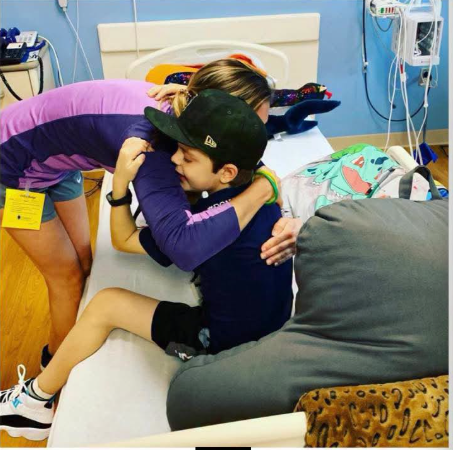
Later, Brayden met Camie again.
There are moments when words are simply not enough. There is no “thank you” large enough to express what it means to know that someone willingly underwent surgery so that you could keep living.
Brayden simply hugged her.
That embrace captured a story that had begun between two strangers. A child desperately needed help, a nurse heard about what was happening, and through an extraordinary combination of medical compatibility and human generosity, their lives became connected forever.
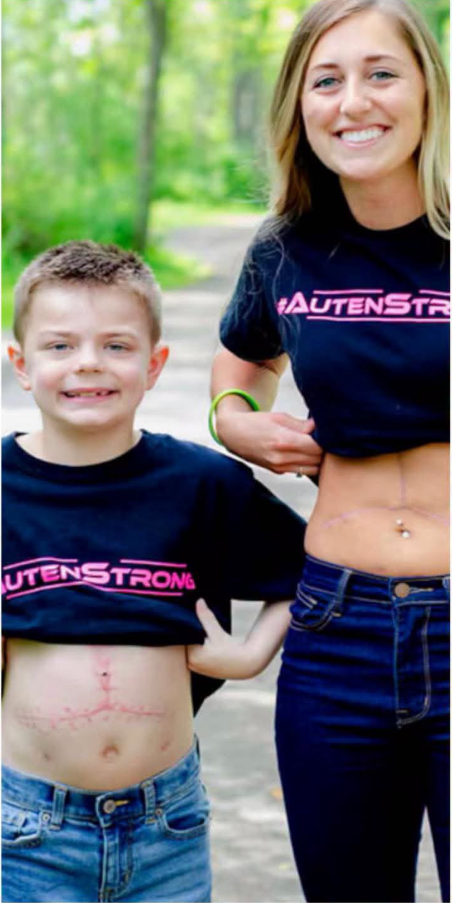
Photographs taken afterward tell their own powerful story. In them, Brayden and Camie can show the scars left on their bodies, two different marks from the same journey. One belongs to the child who received the organ he needed; the other belongs to the woman who chose to give away part of hers.
We often think of scars as reminders of pain. They can represent surgery, illness, or moments people might prefer never to have experienced. But some scars also tell stories about what was saved.
Brayden’s scar speaks of survival.
Camie’s scar speaks of a choice.
Together, they tell the story of how part of one person’s body became an entirely new opportunity for another.
What is especially remarkable is that Camie did not wait for Brayden to become someone close to her before considering whether she could help. She did not need years of friendship, family ties, or a personal debt. She simply heard that a child was in danger and discovered that there was something real she might be able to do.
In a world where difficult stories appear constantly and can leave people feeling powerless, Camie’s response offers a powerful lesson. We cannot answer every tragedy or solve every problem we hear about. But sometimes life places one very specific opportunity in front of us, and in that moment, we really can make a difference.
Camie found one of those moments.
She could have thought of countless reasons not to do it. She had her own life, her own health, and no personal responsibility for what was happening to Brayden. No reasonable person could have said she was obligated to undergo major surgery for him.
And yet she chose to help.
That decision represents a kind of generosity that goes far beyond giving what is easy to spare. Helping is simple when it asks very little of us, but the meaning changes when it requires pain, time, recovery, and personal risk. Camie understood the weight of what she was offering and continued anyway.
For Ruth and James, the decision made by this nurse must have been difficult to fully comprehend at first. They had watched numerous relatives undergo testing without finding a match, and just when hope seemed dependent on an increasingly uncertain possibility, someone they did not even know appeared. The person capable of helping save their son came from outside the circle where they had desperately been searching.
That detail makes the story deeply human.
We often imagine that the people who will transform our lives will be people we already know. We think of parents, siblings, friends or partners as the ones who will stand beside us during the darkest moments. But stories like Brayden’s remind us that sometimes a stranger can appear at exactly the right moment and become someone we will never forget.
Camie went from not knowing Brayden at all to sharing something with him that would remain inside his body. She did not do it because she wanted recognition or because any reward could possibly equal what she was giving. She did it because she had the opportunity to help.
For Brayden, that decision meant a new possibility for the future.
A second chance at life is not made up only of the day a surgery ends successfully. It is made from every morning that comes afterward, every birthday that can be celebrated, every hug that can still be given, and every ordinary moment a family was once afraid it might lose.
Each of those moments carries a different meaning when survival once depended on an urgent transplant.
The story also changes how we think about what it means to be a hero. Movies often show heroes performing spectacular acts, facing visible danger and receiving recognition for what they have done. Real life is often much quieter.
Sometimes a hero works an ordinary shift in a hospital.
Sometimes she hears about a sick child.
Sometimes she fills out forms, undergoes testing, and waits for a result.
And sometimes she eventually lies down on an operating table so that someone she did not know can rise from theirs with another chance at life.
Camie was already a nurse, someone whose profession was built around caring for people at their most vulnerable. But what she did for Brayden went far beyond her professional responsibilities. He was not a patient assigned to her during a shift; he was simply another human being whose need she chose to answer.
That does not mean everyone is expected to make a sacrifice of the same magnitude. Nor does it mean organ donation is ever a simple decision, because any major medical procedure requires careful evaluation and consideration. What makes this story special is that when Camie learned she could do something, she chose to use that possibility to help someone else.
Brayden will likely carry the knowledge for the rest of his life that part of his story began with a woman he had never met. When he looks at his scar, it will not only remind him of the illness that nearly took his future away. It will also be evidence that someone chose to fight for him before she even knew him.
Camie will carry her own scar.
It will remain a permanent reminder of a surgery she never medically needed for herself. But it will also stand as proof that somewhere in the world, a boy was given the chance to continue his story partly because of the decision she made.
It is difficult to imagine a more unusual bond between two people.
It was not created by blood.
It was not built through years of friendship.
It began with a need and a response.
“Someone needs help.”
“Maybe I can help.”
Sometimes an entire lifetime can exist between those two sentences.
Brayden’s story also shows how suddenly life can change for a family. Shortly before becoming ill, he had been a healthy child competing in wrestling and was probably far more concerned about his next match than the possibility of needing a liver transplant. Then suddenly, his family’s entire world was reduced to a single question: would a donor be found in time?
That sudden change is part of what makes his story so moving. Health can feel permanent until the day it is not, and plans can feel certain until one medical crisis forces a family to reconsider everything. No one expects an ordinary childhood to turn into an urgent search for an organ donor.
But then something happened that nobody could have planned.
A stranger appeared.
Not with a miracle cure or an impossible promise, but with something real she could offer: part of her own liver.
That was enough to change the direction of Brayden’s story.
Perhaps that is why the images of Brayden and Camie together are so powerful. We do not need to understand every medical detail to understand what matters most. We see a child and a woman connected by two scars and know that one exists because the other person willingly gave something of herself.
Brayden’s hug probably expressed more than any speech ever could. It was the embrace of a child toward the person who answered when his family was desperately searching for another chance. It was also the meeting of two lives that never would have had a reason to intersect in such an extraordinary way.
Now they will always be connected.
When a story like this is told, it is easy to focus only on Camie’s extraordinary act. But Brayden deserves to be seen too: an eight-year-old who had to endure severe illness, a transplant, and recovery at an age when he should have been thinking only about school, friends and wrestling. His body was forced to show a strength no child should ever need to prove.
And then there are Ruth and James.
During those frightening days, they had to live with one of the worst fears any parent can experience: knowing that their child urgently needed something they could not provide themselves. They watched family members be ruled out one after another and had to trust that somehow another possibility would appear.
Eventually, it did.
But it arrived with a name that initially meant nothing to them: Camie Loritz.
Today, that name is permanently woven into their family’s story.
That is the extraordinary thing about human generosity. A stranger can stop being a stranger in a single moment when they choose to carry part of someone else’s burden. They can step into a story that never belonged to them and change its direction forever.
Camie did not change the entire world.
She did not solve every case of a child waiting for an organ.
She could not.
But she changed Brayden’s world.
And for an eight-year-old boy and his parents, that was the only world that mattered in that moment.
The greatness of an act is not always measured by how many people it affects. Sometimes one life, one family, or one future is enough. When one decision gives someone the opportunity to keep growing, learning, laughing and loving, its impact cannot be reduced to a number.
Brayden received part of a liver.
But he also received time.
Time to recover.
Time to return to his life.
Time to become the person that eight-year-old boy had not yet had the chance to imagine.
Camie gave part of herself so that time could continue.
Perhaps many years from now, Brayden will look again at the photographs of the two of them showing their scars. Maybe he will think about the chapter of his childhood that began with an unexpected illness and ended with a lifelong connection to a nurse who had once been a stranger. With age, he may understand even more deeply the extraordinary nature of what someone chose to do for him.
And Camie may look at those same photographs knowing that behind her scar is a story that continued.
That is what remains when all the medical details are stripped away.
A child needed help.
A woman discovered she could help him.
And she said yes.
Not because she had to.
Not because Brayden was family.
But because life placed the possibility of changing another person’s future in front of her, and she chose not to look away.
Perhaps we will never be able to solve every problem we encounter in the world. Perhaps we cannot even fully understand how much suffering exists around us. But the story of Brayden and Camie reminds us that we do not need to change everything in order to do something extraordinary.
Sometimes changing one life is enough.
And in Brayden Auten’s story, that second chance came in the most unexpected way possible: not through a relative or lifelong friend, but through a nurse who heard that a child needed help.
Two strangers.
Two scars.
One decision.
And a life that was able to continue because, when Camie discovered she could do something, she chose to do it.