There is a truth that is almost impossible for a parent to say out loud.
For 18 months, while our family was fighting desperately to keep Will alive, I unintentionally asked my other child to grow up far too fast.
Her name is Charlie.
She was only 12 years old.
And while so much of our energy, fear, money, attention and hope were focused on saving her brother, Charlie quietly learned how to survive a childhood shaped by cancer.
She never asked for that role.
She never chose it.

But somehow, she stepped into it anyway.
And it took coming home to a house without the sound of Will’s crutches for me to finally understand just how much she had changed.
Our Entire Life Became About Keeping Will Alive
There is no gentle way to explain what happens to a family when one child is seriously ill.
Everything becomes urgent.
Every appointment matters.
Every phone call feels important.
Every new treatment sounds like it might be the one thing that changes everything.
When Will needed something, we went.
When doctors recommended something, we listened.
When we heard there might be another option somewhere else, we chased it.
Our lives stopped being organized around school schedules, vacations, weekend plans or normal family routines.
They became organized around cancer.
Hospital rooms.
Scans.
Treatments.
Medication.
Travel.
Results.
Fear.
Hope.
Then fear again.
We eventually packed up our lives and moved across the country because there was still a chance to help Will.
And when your child is fighting to stay alive, a chance is enough.
You do not stop to ask whether it is convenient.

You go.
But while we were fighting for Will, there was another child standing beside us.
Charlie.
Charlie Had to Share Her Parents With Cancer
I loved both of my children.
That never changed.
But love does not magically create more hours in a day or more emotional strength inside a parent.
One child was dying.
That child needed more from us.
That is the painful truth.
And Charlie had to live with it.
Plans involving her were canceled.
Days that should have been about her became days focused on Will.
Sometimes Mom was gone.
Sometimes Dad was gone.
Sometimes both of us were physically present but mentally somewhere else entirely.
Cancer did not only take Will’s time.
It took Charlie’s too.
She became familiar with things no 12-year-old should ever have to understand.
She knew the smell of hospital disinfectant.
She knew the sound of IV machines beeping from nearby rooms.
She knew the uncomfortable chairs.
The long hallways.
The bags packed for another hospital stay.
She learned what it meant when adults suddenly lowered their voices.
She noticed when conversations stopped because she entered the room.
She noticed when we tried to smile even though something was clearly wrong.
And perhaps most painfully, she became incredibly good at reading emotions nobody was willing to say out loud.
She Learned How Not to Need Us
This is the part I did not understand at the time.
I thought Charlie was coping well.
She was quiet when we needed quiet.
She was patient when plans changed.
She did not complain when attention shifted toward Will.
She seemed mature.
Responsible.

Strong.
For a long time, I saw those things as signs that she was handling everything.
Now I see them differently.
Charlie was learning how not to become another problem.
She watched her parents already carrying something enormous.
So she made herself lighter.
She learned not to ask for too much.
Not to interrupt.
Not to complain.
Not to add another worry to the pile.
That kind of maturity can look beautiful from the outside.
But when it comes from a frightened child trying to protect exhausted parents, it becomes heartbreaking.
She was not simply growing up.
She was adapting to survival.
Charlie Watched Everything Happen to Her Brother
There was no way to completely shield her.
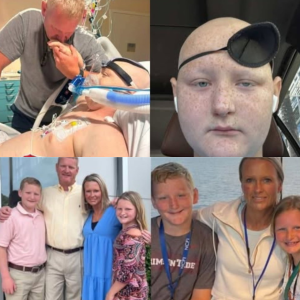
Charlie watched Will lose his leg.
She saw the braces.
The bandages.
The pain.
She saw him learn to walk again.
She saw him fight to rebuild his strength.
Then she watched cancer return.
She watched hope rise and fall again and again.
She watched us search for treatments.
She heard conversations about options, possibilities and timelines.
She watched her brother keep fighting even when his body was exhausted.
And eventually, she witnessed the thing every parent wishes they could have protected a child from.
She watched her brother die.
That is not an ordinary memory for a 12-year-old.
It is not something you simply leave behind when you walk out of a hospital.
Charlie saw Will lying still in a hospital bed.
She stayed in the room after he was gone.
She watched the final moments that marked the end of her brother’s life and the beginning of a completely different childhood for her.
Then she walked out of the hospital beside us.
Her brother stayed behind.
Then the World Somehow Started Again
This may be one of the cruelest parts of grief.

The world does not stop.
School still starts.
People still go to work.
Phones still ring.
Homework still needs to be finished.
Ballgames still happen.
Friends still call.
Traffic still moves.
Everyone else continues living even when your own world feels as though it has collapsed.
We eventually returned home.
And the silence was different.
Will was not there.
There was no sound of his crutches.
No familiar movement.
No random noises that once seemed ordinary.
Suddenly, even the normal sounds of our house felt wrong.
There were backpacks near the door.
Clothes on the floor.
Homework on the table.
The same furniture.
The same walls.
But one child was missing.
And that was when I finally looked more carefully at Charlie.
Really looked at her.
I Realized How Much My Daughter Had Changed
Something about her was different.
It was not one dramatic moment.
It was the collection of small things.
The way she watched people before speaking.
The way she seemed to decide whether her feelings were important enough to mention.
The way she had become so independent.
The way she sometimes carried herself more like an adult than a 12-year-old child.
And suddenly I understood.
Charlie had spent 18 months watching our family revolve around a medical emergency.
She had learned to live around that emergency.
She had learned to reduce her own needs.
She had learned that there were always bigger problems.
And while I had been fighting desperately to save one child, I had not fully seen what the other child was sacrificing.
That realization broke something open inside me.
This Does Not Mean I Chose Will Over Charlie
Parents of seriously ill children often carry enormous guilt.
There is guilt for the child who is sick.
Guilt for the siblings.
Guilt about work.
Marriage.
Money.
Time.
Everything.
But this was never about loving one child more than another.
It was about responding to an emergency.
If one child is fighting for his life, that crisis will naturally demand attention.
The problem is that the sibling experiences the consequences too.
Charlie was not angry because we loved Will.
She loved him too.
She wanted him to survive.
She wanted us to find the treatment.

She wanted the doctors to fix everything.
But cancer forced her to give up pieces of ordinary childhood along the way.
And now that Will is gone, I cannot pretend those pieces do not matter.
Charlie Deserves 12-Year-Old Problems Again
This is what I want for her now.
Ordinary problems.
I want to hear the twenty-minute story about something at school that could have been told in three minutes.
I want to sit in the stands at her games.
I want to wait forever in the school pickup line.
I want to hear complaints about homework.
I want to argue about clothes on the floor.
I want to tell her to put the phone down.
I want to hear her slam a door because she is annoyed with me.
I want her biggest frustration to be something normal.
Because for too long, the problems inside our family were life-and-death problems.
Charlie deserves some ordinary.
She deserves space to be childish again.
To be dramatic.
To be silly.
To be irritated.
To make mistakes.
To need help.
To need attention.
She should not have to be “the strong one” every day.
We Will Never Stop Talking About Will
Choosing Charlie does not mean forgetting Will.
That is not possible.
His name will still be spoken in our house.
His photos will remain.
His stories will be told.
We will laugh about the things he did.
We will cry when grief hits unexpectedly.
Some days his absence will feel heavier than others.
Charlie should never have to feel as though loving life means leaving her brother behind.
Neither should we.
But I have learned something that changed the way I understand grief.
I cannot spend the rest of my life staring so intensely at the child I lost that I fail to see the child who is still standing in front of me.
Will matters.
Charlie matters too.
Both truths can exist at the same time.
Charlie Is More Than “Will’s Little Sister”
This may be one of the most important things I want people to understand.
Charlie is not simply the sister of a boy who died from cancer.
That cannot become her entire identity.
She is not just part of Will’s story.
She has her own story.
She has dreams that have nothing to do with cancer.
She has friendships.
Interests.
Failures.
Successes.
Bad moods.
Future plans.
She is still becoming herself.
Cancer already took enough from her childhood.
I do not want grief to take the rest.
I Cannot Change What Happened, but I Can Change What Happens Next
There are things I will always wish I could redo.
I wish I could give Charlie back the days she lost.
I wish she had never learned what a hospital hallway feels like late at night.
I wish she had never had to see her brother sick.
I wish she had never watched him die.
I wish I had been able to protect both children from everything.
But parenting after loss means accepting that some things cannot be changed.
I could not give Will the ending I wanted.
I could not save him despite everything we tried.
And I cannot erase what Charlie saw.
But I can decide what I do now.
I can show up.
I can listen.
I can sit in the stands.
I can wait in the pickup line.
I can ask about her day and actually hear the answer.
I can notice when she is struggling.
I can remind her that she never has to make herself smaller to make life easier for us.
For the First Time, She Does Not Have to Share Me With Cancer
For nearly two years, I was always fighting something.
Researching.
Packing.
Calling.
Driving.
Waiting.
Trying to save Will.
That fight is over now.
That sentence hurts to write.
But it is true.
Will does not need another hospital bag.
He does not need me searching for another treatment.
He does not need another phone call to another specialist.
He does not need me to figure out how to save him anymore.
I believe he is at peace.
Charlie is still here.
And she still needs her mother.
She needs guidance.
Protection.
Attention.
Patience.
She needs someone in the stands when she looks up.
She needs someone listening when she walks through the door.
She needs someone who notices her before she has to ask to be noticed.
Maybe this is part of learning how to live after losing a child.
You continue loving the one you lost.
But you also learn how to love the ones who remain without allowing grief to make them disappear.
For 18 months, Charlie had to share her parents with cancer.
She waited.
She adapted.
She grew stronger than any child should have needed to become.
And now, for the first time in almost two years, she no longer has to compete with appointments, hospitals, treatments or emergencies for my attention.
She does not have to stand quietly beside a packed bag wondering what happens next.
She does not have to protect me from her problems.
She does not have to make herself smaller.
She is Charlie.
She is 12.
She is still here.
And now she gets all of me.