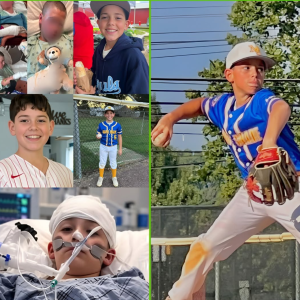
When the internet adopts a dying child, it creates a massive, noisy vacuum that swallows everything surrounding that child. When fifteen-year-old Will Roberts lost his battle with cancer, the digital world exploded into a collective performance of mourning. Millions of strangers posted glowing tributes, edited emotional tribute videos, and turned his short life into an eternal monument of bravery and divine inspiration. But far away from the glowing screens, the news cameras, and the endless stream of notifications sending condolences from across the globe, a quiet, devastating collapse was occurring in the shadowy corner of a childhood bedroom. That was where Will’s little sister sat, surrounded by leftover toys and quiet memories, trying to navigate a loss that the internet was completely incapable of understanding.

To the millions of people scrolling through social media feeds during their morning routines, Will was an iconic figure, a courageous teenage hero who fought against impossible odds while maintaining a bright, unforgettable smile. But to a little sister, he was never a hero on a pedestal, nor was he a symbol of human resilience meant to inspire millions of adults he had never met. He was simply her big brother. He was the person who teased her relentlessly over the last slice of pizza, the accomplice who helped her build living room blanket forts on rainy weekends, the protector who walked her home from school, and the constant, immovable anchor of her small, private universe. While the rest of the world was consumed by the dramatic, high-stakes medical saga playing out online, her reality was composed of tiny, ordinary moments that never generated a single like, share, or headline.
There is a profound, almost sinister cruelty in how a viral tragedy reshapes the internal dynamics of a grieving family, particularly for young siblings who are forced to mourn under the long shadow of public obsession. When a child becomes a public figure due to an impending tragedy, the immediate family’s private sanctuary is subtly invaded by the demands of an insatiable audience. The little sister’s grief is suddenly forced to compete with the collective grief of millions of strangers who feel entitled to a piece of her brother’s memory. While the world demands heroic narratives and dramatic emotional resolution, a child’s loss is messy, quiet, confusing, and intensely personal. She is left to process the terrifying reality that the person who shared her childhood has vanished, while the rest of the world celebrates a fictionalized, polished version of him that barely resembles the boy who used to steal her headphones.

As the years pass and the digital tide eventually recedes, moving on to the next viral tragedy of the week, the public forgets, but the surviving sibling enters a long, silent lifetime of absence. The hardest part of this tragedy for a younger sister is not the overwhelming grief of the immediate aftermath, nor is it the surreal experience of seeing her brother’s face plastered across social media feeds. The true, agonizing weight arrives in the quiet, mundane milestones of the future—the moments that are completely invisible to an online audience. It is the realization that he will not be sitting in the bleachers at her high school graduation, that he will not be there to give terrible advice before her first date, that he will not share an knowing glance across the dinner table during family holidays, and that his laughter will slowly fade into a distant, echoic memory that no recorded video clip can fully restore.
Modern society has developed an unhealthy obsession with romanticizing human suffering, turning personal family catastrophes into consumable digital content that flatters the emotional ego of the viewer. We watch these stories unfold from behind the safe, sterile glass of our smartphones, feeling a fleeting surge of deep emotion that makes us feel connected and compassionate, before we casually swipe down to the next post. But for the little sister standing in the quiet hallway of a house that suddenly feels far too large, there is no swiping away from the void. The global audience gets to close the app and return to their normal, intact lives, while she is left behind to clean up the shattered pieces of a family that will never be whole again. The public consumes the tragedy as a brief, moving chapter in their daily entertainment feed, but for the sibling, it is the defining fracture of her entire existence.
When a family goes through a public loss, the surviving child is often thrust into a bizarre, performative role that steals their right to grieve authentically. They are expected to be brave, to smile through tears for supportive online followers, and to carry the weight of their sibling’s grand legacy while they are still just trying to understand why their world fell apart. This pressure forces them to suppress their raw, chaotic emotions—the anger, the jealousy, the profound loneliness, and the simple desire to have their normal, annoying brother back instead of an immortalized icon. A child should be allowed to cry without an audience analyzing their strength, to be angry at the universe without being told to find divine comfort, and to remember their sibling as a real, flawed human being rather than an idealized saint created by the comment section.
The fundamental disconnect between public mourning and private loss highlights a deep failure in how our digital culture understands grief. An algorithm can track views, measure engagement, and amplify trending hashtags across six continents, but it can never measure the crushing weight of a silent bedroom, the painful sight of an untouched backpack sitting near the front door, or the quiet desperation of a little girl realizing that her big brother will never walk through that door again. The public believes that by participating in the online spectacle, they are honoring the deceased and supporting the family, but in reality, they are often commodifying a private horror that belongs exclusively to the people inside those four walls. The true story of Will Roberts was never the viral video that gained millions of impressions; it was the quiet, invisible bond between a brother and sister that existed before the world ever knew his name.

Ultimately, the most heartbreaking truth of sibling loss in the digital era is that no amount of global admiration can ever fill the physical void left behind in a home. Millions of people can leave sympathetic comments calling Will an eternal inspiration, but none of them will ever step in to fill the role of the big brother who was supposed to stand beside his little sister through every chapter of her life. As time moves forward and the world continues its endless, restless scroll through the suffering of others, we must remember that behind every viral headline of tragedy lies a private family enduring a quiet, permanent fracture—and a little sister who would gladly trade every view, share, and tribute in the world just to hear her big brother call her name one last time.