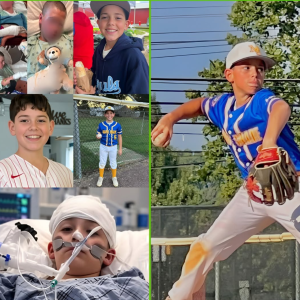
There is a sacred, heavy silence that governs a house after a long illness claims a child. For months after teenager Will passed away, his bedroom remained an untouchable shrine, a quiet corner of the home where time seemed to stand still while the rest of the world kept moving forward. His family walked past that closed wooden door on tiptoe, treating the space with a mixture of reverence, fear, and profound sorrow. The doorknob remained untouched, holding inside a airless snapshot of Will’s final days—his unmade bed, his stacked textbooks, and the small personal items that carried the fading essence of his presence. Everyone in the household knew the door was there, but no one possessed the courage to turn the handle and face the full, unyielding weight of what lay on the other side.
That was until late one quiet evening, when seven-year-old Charlie found herself standing in the dimly lit hallway alone. Driven by a deep, undeniable longing to feel close to the older brother who had been her protector, her confidant, and her hero, she reached out her small hand and slowly pushed the door open. What she encountered inside was not a scene of cold, lingering grief, but a startlingly intimate discovery that left her entirely unable to speak. Resting on the center of Will’s desk, bathed in the soft moonlight filtering through the window, was a small leather-bound notebook left open to its final pages, flanked by a collection of handwritten notes, carefully drawn sketches, and a series of labeled envelopes addressed directly to her.

In those final, agonizing weeks when Will knew his time was running short, he had quietly spent his remaining strength documenting a personal guide for his little sister. Page after page was filled with meticulous details only a devoted brother would think to record: advice on how to handle middle school, reminders of their favorite inside jokes, step-by-step instructions on how to care for his beloved possessions, and gentle, reassuring promises that whenever she felt alone, his love would still surround her. Sitting on the cold floor surrounded by his handwriting, Charlie was overcome by a wave of raw emotion so powerful it threatened to consume her tiny frame. It was in that very room, surrounded by the physical proof of her brother’s extraordinary love, that she decided she could no longer keep her overwhelming sorrow trapped inside.
Later that same night, clutching her brother’s notebook tightly against her chest, Charlie sat down in front of a camera and recorded a message intended for everyone who had followed Will’s journey and were still grieving along with their family. Her small voice trembled as she faced the lens, but her determination never faltered. She spoke candidly about the surreal experience of walking into his quiet room, the overwhelming power of the discovery she had made, and the profound void that exists when a vibrant life is suddenly cut short. But as the recording drew to a close, a heartbreaking plea escaped her lips—a raw, unscripted request that begged the world not to let Will’s legacy fade into polite silence, but to let his spirit inspire acts of unconditional kindness every single day. When her mother discovered the video hours later and heard those tearful words, the emotional dam broke completely, leaving her weeping in the hallway as she realized the true depth of her daughter’s strength and pain.
This poignant moment serves as a powerful entry point into a much larger, often unspoken conversation regarding the complex mechanics of grief within modern families. When a family experiences the catastrophic loss of a child, the immediate aftermath is frequently characterized by an instinctual desire to freeze time. Parents, overwhelmed by the sheer magnitude of their heartbreak, often preserve physical spaces like a child’s bedroom as a way to maintain a tangible connection to the person they lost. While this preservation can offer temporary comfort, it can also unintentionally create an environment where surviving children feel caught between honoring a memory and processing their own living, breathing sorrow.
Charlie’s decision to cross that threshold and enter her brother’s room highlights the incredible, innate resilience of children when facing profound loss. Where adults often see a sanctuary of pain too painful to disturb, children often seek out truth, connection, and continuity. The discovery Charlie made inside that room serves as a stark reminder that young people possess a remarkable capacity to engage with heavy emotional realities if they are given the space to do so. Her story challenges the widespread cultural belief that children must be sheltered from the physical remnants of death in order to protect their psychological well-being.

Furthermore, the overwhelming public response to Charlie’s recorded plea sheds light on the phenomenon of collective mourning in the digital age. In generations past, a family’s grief remained largely confined within the walls of their home or their immediate local neighborhood. Today, through shared media and online communities, the private heartbreak of one household can quickly resonate with thousands, or even millions, of individuals around the globe. This shift has altered how society processes empathy, allowing strangers from vastly different walks of life to unite in support of a grieving child.
However, this public visibility also brings significant questions regarding how we sustain long-term support for grieving families once the initial wave of public attention recedes. A recurring theme in Charlie’s plea was the terrifying fear that as weeks turn into months, people will naturally move on, return to their busy lives, and gradually forget the unique light that her brother brought into the world. This fear is shared by virtually everyone who has suffered a major loss. The initial outpouring of sympathy, flowers, and supportive comments often creates a temporary cushion, but when the noise subsides, the quiet reality of permanent absence sets in with crushing force.
The story of Charlie entering Will’s room and sharing her heart with the world serves as an urgent call to action for communities everywhere. It asks us to look beyond superficial condolences and consider how we can build lasting frameworks of support for bereaved families, particularly for the surviving siblings who must navigate their formative years in the shadow of loss. Pediatric grief specialists continuously emphasize that surviving children require open communication, validated emotions, and permission to express their sorrow in ways that feel authentic to them, rather than being expected to adhere to adult standards of composure.
By choosing to speak out, Charlie transformed her personal heartbreak into a universal message about love, memory, and the enduring power of family bonds. The small notes left behind by Will were not just a gift to his sister; they were a testament to the incredible foresight and empathy of a young man who wanted to ensure his love would outlast his physical presence. In turn, Charlie’s brave decision to share her discovery ensured that her brother’s final wish would be heard far beyond the four walls of his quiet bedroom.

Ultimately, the smallest voice in that quiet house carried the deepest, most transformative message imaginable. Charlie’s story reminds us all that grief is not something to be hidden behind closed doors or spoken of in hushed, fearful tones. It is a profound expression of love that deserves to be honored openly, shared courageously, and carried collectively. As we reflect on the image of a little girl standing alone in her brother’s room, faced with the overwhelming physical evidence of his love, we are challenged to examine how we show up for those who are suffering around us, ensuring that no grieving heart is ever left to walk through the dark alone.