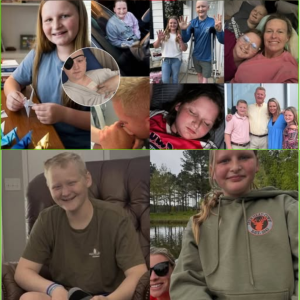
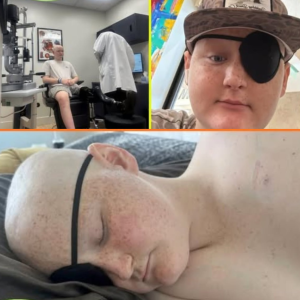
For months, thousands of people following 15-year-old Will Roberts believed they understood the battle unfolding inside his hospital room.
Will was fighting cancer.
It was brutal, exhausting, and frightening—but it had a name. His family could talk about treatments, scans, medications, and the hope that another option might give him more time.
Then everything changed.
According to the latest updates shared by Will’s family, cancer may no longer be the most immediate danger facing his weakened body. A severe fluid crisis has reportedly become one of the most urgent problems doctors are trying to control, placing pressure on a body already exhausted by months of treatment and complications.
For supporters who have followed Will’s journey, the news was difficult to process.
The disease everyone had feared most was still present. But now another threat had moved to the center of the fight.
A Crisis His Body Cannot Easily Escape

Will’s family has previously described significant fluid buildup around his lungs and inside his abdomen. The excess fluid has affected his breathing, comfort, mobility, and the way his medical team must approach nearly every decision.
In an otherwise healthy person, the body constantly manages fluid through the kidneys, bloodstream, and lymphatic system. But in a critically ill patient, that balance can become dangerously unstable.
Fluid can collect where it does not belong.
When it gathers around the lungs, breathing may become more difficult. When it builds inside the abdomen and surrounding tissues, it can increase swelling, discomfort, and pressure on already strained organs.
According to his family, Will’s medical team has used drainage procedures and medications intended to help his body release some of the excess fluid. At one point, more than two liters were reportedly removed, bringing him a measure of relief and allowing him to breathe more comfortably.
But removing fluid is not always a simple solution.
Doctors must carefully balance the need to reduce swelling with the risk of placing additional stress on the kidneys, blood pressure, and circulation. If fluid is removed too aggressively, the body may struggle to adjust. If it is removed too slowly, the pressure and swelling may continue to worsen.
That delicate balance has transformed each hour into a new medical calculation.
How much fluid can Will’s body safely lose?
Can his kidneys continue handling the strain?
Will the fluid return?
And how much strength does his exhausted body still have left?
The Numbers Behind the Bedside Fear

Hospital updates are often filled with numbers—oxygen levels, heart rate, kidney values, hemoglobin, platelets, and urine output.
To families, those numbers are never just statistics.
They determine whether a child can rest, eat, drink, sit up, receive treatment, or avoid another procedure.
Will’s family has said his doctors have adjusted medications as kidney-related laboratory values changed. Even after one medication used to remove fluid was reduced, Will reportedly produced more than a liter of urine on his own—a small but meaningful sign that his body was still responding.
Yet the situation remained fragile.
His platelet count had fallen. His hemoglobin required close monitoring. Earlier concerns about possible gastrointestinal bleeding led to additional medication and restrictions on eating and drinking.
Every improvement seemed to arrive beside another warning.
That is what makes critical illness so difficult for families to explain to the outside world. A child can have one encouraging hour and still face a dangerous night. A successful treatment can create a new risk. A small victory can exist beside a frightening laboratory result.
For Will’s parents, Brittney and Jason Roberts, hope has never meant pretending the danger is not real.
It has meant standing beside him while fully understanding how serious that danger has become.
The Conversation About Heaven

Then came the moment that left supporters struggling to hold back tears.
Brittney shared that Will had spoken quietly about Heaven.
The conversation was not described as a dramatic farewell. It was something more intimate—a reflection from a teenager who had endured pain, uncertainty, and decisions no child should ever have to make.
What struck his family was not fear.
It was his calmness.
Will’s words reportedly reflected the same faith he has shown throughout the most difficult moments of his illness. Even after hearing devastating possibilities, he continued to speak about trusting God.
At another point in his journey, when the possibility of returning home was discussed, Will reportedly told his mother, “You’ve got to have faith.”
Those words have become central to the way his family understands this fight.
Faith, for them, is not a guarantee that every medical update will be good. It is not a refusal to listen to doctors. It is the belief that Will’s life remains meaningful in every moment—and that the family will not abandon hope simply because the road has become frightening.
“We Will Keep Fighting”
The Roberts family has faced criticism from people who do not understand the medical decisions being made behind closed hospital doors.
Some have questioned why they continue pursuing treatment. Others have accused them of prolonging suffering.
Brittney has responded by explaining that these choices are not simple, and they are not being made carelessly.
Will has remained part of those conversations.
His parents have repeatedly emphasized that they are listening to him, listening to his doctors, and trying to protect both his comfort and his chance to keep fighting.
Their promise is not that they can control the outcome.
Their promise is that Will will not face it alone.
Jason continues staying with him overnight in the intensive care unit, where only one parent can remain. Brittney stays nearby with other family members, returning to the hospital each day. Nurses help Will sit in a chair, move safely, and experience small moments of normalcy amid the machines and alarms.
A visit from a therapy dog recently caused Will to light up and reach down to pet the animal himself.
To many people, that might appear insignificant.
To his family, it was evidence that Will was still present, still responding, and still finding moments of connection inside a room dominated by medical uncertainty.
Cancer remains part of Will Roberts’ battle.
But tonight, it may not be the only enemy—or even the one demanding the most immediate attention.
The greatest danger may be the crisis his exhausted body can no longer easily control: fluid building faster than his organs can safely remove it.
And as doctors watch the numbers, adjust medications, and make decisions hour by hour, Will’s family continues repeating the promise that has carried them through every setback:
They will keep fighting beside him until God says otherwise.