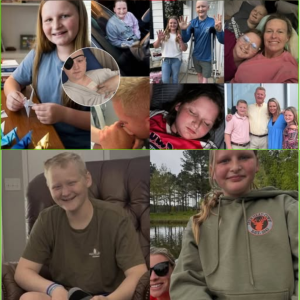
he kitchen table was littered with square scraps of colorful paper, their edges sharp against the worn wooden surface where homework used to be spread out. Ten-year-old Charlie sat hunched over the pile, her fingers moving with a quiet, deliberate intent that felt entirely too heavy for a child her age. Her small hands systematically creased paper into tight, sharp folds, forming delicate wings, long slender necks, and pointed beaks. One by one, colorful paper cranes were strung together on long threads, suspended like fragile paper birds frozen in mid-flight above the table.
Brittney had watched her daughter with a mixture of profound warmth and unspoken heartache for three straight weeks. The loss of Will—her eldest child, Charlie’s older brother—had left a crater in their home, an invisible chasm that every family member navigated in complete, suffocating silence. When Charlie first announced her plan to fold a thousand origami cranes, referencing the ancient belief that completion of the task would earn the maker a granted wish, Brittney assumed it was a sweet, desperate attempt at child-like bargaining with the universe.

In Brittney’s mind, the secret wish was obvious. Any mother watching a grieving ten-year-old spend late nights folding paper until her fingertips were sore would assume the child was wishing for the impossible: to turn back the clock, to bring Will home, or to wake up from the endless nightmare of his absence. It was a comforting, heartbreaking assumption that fit neatly into how adults understand a child’s heartbreak.
Yet, when Brittney sat down beside her daughter, gently placing a warm hand on her small shoulder and asking if she was wishing for her brother to come back, Charlie stopped mid-fold. The young girl slowly turned her head, looked straight into her mother’s eyes with an eerie, quiet maturity, and softly shook her head. “No, Mom… I’m not wishing for Will to come back,” Charlie whispered, leaning closer so her words barely skimmed the quiet air between them. “I’m wishing that Will can finally forget how much it hurt to stay here, and that Dad can stop trying to follow him.”
Brittney froze. The breath left her lungs instantly, as if the room had suddenly run out of air. In that single, chilling whisper, the neat narrative Brittney had constructed about her daughter’s innocence evaporated entirely. Charlie was not folded in an act of naive hope; she was bearing witness to the unspoken collapse of her household with a frightening, razor-sharp clarity that the adults around her thought they had successfully hidden.
The Invisible Observers of Human Tragedy
Adults often operate under the comforting illusion that children are protected by their ignorance. We convince ourselves that as long as we keep our voices down, wipe away our tears before opening the bedroom door, and maintain a facade of functional routine, young minds remain shielded from the brunt of severe trauma. We treat children as passive passengers in the family vehicle, assuming they lack the emotional literacy to process the subterranean shifts taking place around them.

Charlie’s secret wish exposes the profound fallacy of this belief. Children do not process grief through the complex vocabulary or clinical frameworks that adults use, but they possess an almost uncanny hyper-awareness of emotional atmosphere. They absorb the unspoken tensions, the lingering pauses in conversation, the shadowed expressions under eyes, and the subtle, terrifying shifts in human behavior that adults assume go unnoticed.
While Brittney was consumed by her own sorrow and focused on keeping the household afloat, and while Jason withdrew into his silent, obsessive rituals, Charlie was quietly observing both of them. She didn’t just see her brother’s empty chair; she saw the heavy, suffocating atmosphere of a home where grief had replaced air. She didn’t just see her father cleaning Will’s room every day; she recognized the dangerous, quiet detachment of a man slowly unspooling from life itself.
When a child lives in an environment saturated with unexpressed pain, they often become emotional sponges. Lacking the power to directly intervene or change adult behavior, they absorb the ambient suffering around them and seek creative, symbolic outlets to process the immense weight they carry.
The Misunderstood Wisdom of Childhood Wishes
The ancient Japanese legend of Senbazuru—the stringing together of a thousand origami cranes—is traditionally associated with healing, longevity, and the granting of a single, powerful wish by the heavens. In modern culture, we often romanticize this practice as a poetic symbol of hope. But when undertaken by a ten-year-old child in the wake of a family tragedy, it becomes something far more complex: an act of profound emotional labor.
Adults frequently mistake a child’s symbolic actions for simple play or naive superstition. When Brittney saw Charlie folding paper, she projected her own adult desires onto her daughter, assuming the child wanted what every grieving adult secretly craves—a undoing of the past. But children are often far more grounded in the immediate reality of their emotional environment than adults give them credit for.

Charlie’s refusal to wish for Will’s return reveals a remarkably mature acceptance of death’s finality. She understood, at ten years old, that dead loved ones cannot be brought back. What chilled Brittney to the bone was that Charlie’s focus had turned entirely toward the living—and toward the hidden, agonizing truth of her brother’s final days.
Her wish was two-fold, targeting the two most painful dynamics in her broken home: the unseen pain her brother had carried before he died, and the terrifying, silent descent of her father. In asking for Will to “forget how much it hurt to stay here,” Charlie demonstrated that she had sensed her brother’s internal suffering long before the adults had acknowledged it. In asking for her father to “stop trying to follow him,” she revealed that she was paying attention to the subtle, frightening signs of a parent whose soul was gradually checking out of existence.
The Heavy Burden of Parentification in Grief
When catastrophic loss hits a family unit, the traditional hierarchy of care often collapses. Parents, overwhelmed by the sheer magnitude of their personal sorrow, may temporarily lose the emotional capacity to act as the grounded, protective pillars their surviving children desperately need. In these quiet, unacknowledged vacuums, surviving siblings frequently step into an implicit, dangerous role: the emotional caretaker of the household.
This phenomenon, known psychologically as parentification, occurs when a child feels subconsciously responsible for managing the emotional state of their parents or stabilizing a chaotic domestic environment. Charlie’s obsessive paper folding was not merely an act of personal mourning; it was a self-imposed mission to rescue her surviving family members from complete emotional annihilation.

A child carrying this burden operates under a silent, terrifying pressure. They realize that the adults who are supposed to protect them are currently broken, leaving the child feeling entirely alone in their vigilance. They begin to hyper-analyze every sign, every heavy sigh, and every closed door.
Charlie’s wish wasn’t a wish for herself; it was an intercession for her family. She was using her small hands to construct a bridge out of paper, attempting to carry the weight that her parents were unknowingly dropping onto her frail shoulders. The tragedy of her situation lies in the fact that no ten-year-old should ever feel required to save their father from his own grief, nor should they feel the weight of agonizing over a lost brother’s hidden suffering.
The Dangerous Silence of Unaddressed Family Trauma
The dynamic within Will’s family illustrates how silence, often used as a mechanism to protect loved ones, can become the most destructive force in a home after a tragedy. Jason chose absolute silence and meticulous routine to contain his pain. Brittney chose quiet observation, trying to maintain an illusion of stability. Neither of them engaged in open, raw, honest communication with Charlie about the reality of what had happened and how they were all surviving it.
This well-intentioned silence created a terrifying breeding ground for isolation. When adults do not talk about grief, children do not stop thinking about it; they simply stop asking questions. They draw their own conclusions, process their terror in solitude, and carry massive, unvoiced anxieties that slowly erode their sense of safety.

Charlie’s observation that her father was “trying to follow” Will is a devastating testament to what happens when grief is left to curdle in secret. Children notice when a parent is present in body but absent in spirit. They recognize when a father’s eyes look entirely hollow, or when his daily rituals look less like remembrance and more like a slow retreat from the living world.
If Charlie had kept her wish to herself, if Brittney had never leaned in to ask the simple question, that family might have continued sliding down their separate, isolated paths of silent despair. The paper cranes were Charlie’s beacon, a quiet emergency flare launched from the heart of a child who refused to let her family drown in unspoken tragedy.
Reclaiming the Narrative of Hope from the Ashes of Loss
The moment Charlie whispered her real wish to Brittney, the paradigm of the entire household shifted. It was a terrifying, painful wake-up call that shattered Brittney’s passive grief and forced her back into the present moment. It reminded her that while one child was gone, another was sitting right beside her, quietly drowning under the weight of adult sorrow.
True healing inside a grieving family does not begin when everyone pretends to be okay, nor does it begin when the pain miraculously vanishes. It begins in the exact moment when the silence is broken—when the raw, terrifying truths are laid out on the table alongside the paper scraps and the unfinished cranes.
Brittney’s realization was painful, but it was also the first step toward salvation for her remaining family. It called for an immediate end to the performative stoicism that was slowly killing her husband and terrifying her daughter. It demanded that the adults step back into their roles as protectors, relieving Charlie of the impossible burden of saving her home through paper wishes.
The thousand cranes were never going to fly, nor were they going to magically heal the shattered pieces of a broken heart. But in their delicate, folded paper wings, they held something far more valuable: an undeniable, piercing truth that demanded to be heard.
The Lessons Embedded in Paper Wings
We often look at tragedy through the lens of what has been lost, forgetting to look closely at what remains right in front of us. Charlie’s story is a profound, unforgettable reminder that childhood innocence is not equivalent to blindness, and that the quietest voices in a home are often carrying the heaviest burdens.
When we navigate severe loss, we must remember that our children are not merely watching us mourn; they are learning how to survive by observing our relationship with pain. If we show them that grief must be buried in secret rooms, met with silent withdrawal, or suffered alone behind locked doors, we teach them to bear their own pain in dangerous, solitary ways.
To truly honor those we have lost, we cannot allow our devotion to the dead to eclipse our duty to the living. Love requires us to drop our stoic shields, to look our surviving children in the eye, and to assure them that no matter how deep the night gets, they do not have to fold a thousand cranes to save us.
The desk in Will’s room may remain clean, and the loss will undoubtedly shape every single day that follows. But as long as a family chooses to speak their deepest fears aloud, to share the terrifying burden of unspoken wishes, and to hold each other through the darkest hours, the paper cranes can finally cease to be a child’s desperate plea for help—and become what they were always meant to be: a quiet, gentle monument to love that refuses to die.