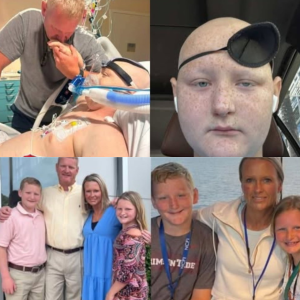
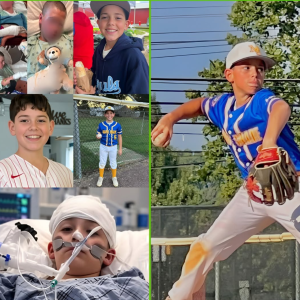
What happens when a mother decides that grief has already taken enough — and refuses to let it steal the childhood of the daughter still standing beside her?
For Brittney, that question became painfully real after the death of her son, Will.
For months, the family’s world had revolved around hospitals, treatments, appointments, test results, medications, and the constant fear of losing him. Every day had been about survival. Every conversation seemed to begin and end with Will’s condition.
And while Brittney would have given anything to save her son, she gradually began to understand another heartbreaking truth.
Charlie had been surviving too.
She had simply been doing it quietly.
A Mother’s Promise After Losing Her Son

After Will died from cancer, Brittney made herself a promise.
She could not bring him back.
She could not rewrite the months spent in hospital rooms or erase the memories of watching her child suffer.
But she could still protect Charlie.
She could make sure her daughter’s childhood did not disappear beneath the weight of her brother’s death.
Brittney wanted Charlie to be more than “the little girl whose brother died.”
She wanted people to ask Charlie about school, her friends, soccer practice, homework, music, and all the ordinary things that should matter to a 12-year-old.
She wanted to hear her daughter complain about teachers.
She wanted to sit through endless stories about something that happened at lunch.
She wanted to watch her play soccer under an unbearable 40-degree sun and cheer as loudly as every other parent.
She even wanted the arguments.
The slammed doors.
The eye rolls.
The dramatic sighs that came with being 12 years old.
Because all of those things were signs of something incredibly precious.
Normal life.
After spending so long living beside death, normal life suddenly felt like a miracle.
The Child Who Learned Not to Ask for Too Much
During Will’s illness, Charlie had become unusually independent.
She understood that her brother needed their parents.
She understood that appointments could not be moved.
She understood that emergencies happened.

She learned to wait.
If her mother was tired, Charlie stopped asking questions.
If her father was on the phone with doctors, she stayed quiet.
If a soccer game conflicted with a hospital visit, she did not complain.
At first, Brittney saw this maturity as strength.
Later, she began to wonder if it had come at a cost.
Children living alongside a seriously ill sibling often learn to make themselves smaller.
Not because anyone tells them to.
But because they can see the pain surrounding the family.
They do not want to add another problem.
So they become “the easy child.”
The child who says, “It’s okay.”
The child who waits.
The child who stops asking.
Charlie had become very good at saying she was fine.
Maybe too good.
Preparing for a New School Year
When the new school year approached, Brittney decided she wanted things to feel different.
No hospital schedules.
No waiting rooms.
No discussions about blood counts or scans.
Just school supplies.
Books.
Uniforms.
Soccer practice.
Lunch boxes.
Ordinary chaos.
One evening, she went into Charlie’s room to help organize her books.

It was the kind of small parenting task Brittney had dreamed about during the worst days of Will’s treatment.
She stacked notebooks, checked school materials, and began sorting through Charlie’s textbooks.
Then she noticed something strange.
On the cover of one book, Charlie’s name had been covered with correction fluid.
Brittney paused.
At first she assumed it had been an accident.
Maybe Charlie had written the wrong class.
Maybe she wanted to rewrite her name more neatly.
Then Brittney picked up another book.
The same thing.
“Charlie” had been covered in white.
She reached for another.
Again.
And another.
Every book showed the same pattern.
The name Charlie had been erased.
One Strange Word Appeared Instead
Brittney’s confusion quickly turned into unease.
Because Charlie had not simply removed her name.
She had replaced it.
Written carefully in the space where her name should have been was the same word on every book:
“Sister.”
Not Charlie.
Not her full name.
Not a nickname.
Sister.
Brittney stared at the word for several seconds, trying to understand what she was seeing.
Then she opened one of the books.
Inside, on the first page, Charlie had written something else.
A small sentence.
One that Brittney would later wish she had never needed to read.
It said:
“That’s what everyone knows me as now.”
Có thể là hình ảnh về bệnh viện và văn bản
The room seemed to become completely silent.
“The Girl Whose Brother Died”
In the months after Will’s death, people had tried to be kind.
Teachers.
Parents.
Neighbors.
Friends.
But kindness sometimes came wrapped in language that Charlie could not escape.
“That poor girl.”
“Will’s little sister.”
“The one who lost her brother.”
People lowered their voices around her.
Adults gave her long, sympathetic looks.
Some hugged her without asking.
Others asked how her mother was coping.
Almost nobody asked Charlie how her math test went.
Or whether she had scored at soccer.
Or what song she liked.
Without anyone intending it, grief had slowly become her identity.
Charlie had stopped feeling like Charlie.
She had become Will’s sister.
The grieving child.
The surviving sibling.
The girl everyone felt sorry for.
And somewhere along the way, she had begun to believe that perhaps her own name no longer mattered.
The Secret Behind the Book Covers
Có thể là hình ảnh về bệnh viện và văn bản
Brittney later found another note tucked inside one of the books.
Charlie had apparently written it weeks earlier.
The words were simple.
But they carried the weight of everything she had kept inside.
She wrote that when Will was sick, she understood why everyone asked about him.
When he died, she understood why everyone cried.
But she did not know when people would start seeing her again.
She missed her brother terribly.
She also missed herself.
That was the part Brittney had not expected.
Charlie did not want to forget Will.
She did not want the family to stop talking about him.
She did not resent him for being sick.
She simply wanted permission to exist outside his tragedy.
That distinction broke something open inside her mother.
Why Brittney Broke Down That Night
Brittney sat on the floor holding one of the books and cried.
Not quietly.
Not politely.
She cried with the force of a mother suddenly realizing that grief had been hurting another child in a way she had failed to see.
She had spent so much time worrying that Charlie might feel forgotten.
Now she had found proof that, in some ways, Charlie already did.
The white correction marks on the books were more than a strange habit.
They were a message.
Charlie had literally erased her own name.
Not because she disliked it.
But because she had started believing that everyone else had replaced it first.
That realization was devastating.
The Conversation That Followed
Later that night, Brittney sat beside Charlie.
She did not begin with questions.
She did not ask why she had damaged the books.
She simply placed one of them between them.
Charlie immediately looked away.
Then Brittney said the words she wished she had said more often.
“You are Charlie.”
The girl’s eyes filled with tears.
Her mother continued.
“You are Will’s sister. You will always be Will’s sister. But that is not the only thing you are.”
Charlie started crying.
Months of emotion seemed to surface at once.
She admitted that she sometimes felt guilty when she laughed.
She felt guilty when she had fun with friends.
She worried that enjoying her life meant she was leaving Will behind.
And she hated when people looked at her with pity before they even spoke to her.
Brittney listened.
She did not correct her feelings.
She did not tell her to be strong.
She simply listened.
Reclaiming Charlie’s Childhood
The next morning, they replaced the labels on the books.
This time Brittney handed Charlie the marker.
Charlie wrote her own name.
Slowly.
Clearly.
Charlie.
It was a tiny moment.
But for Brittney, it represented something much larger.
The family would always carry Will with them.
There would always be photographs.
Birthdays.
Anniversaries.
Memories.
There would always be moments when grief arrived without warning.
But loving Will did not require Charlie to disappear.
Remembering one child did not mean losing another.
That became Brittney’s new mission.
Not to “move on” from her son.
But to move forward with her daughter.
The Hidden Grief of Surviving Siblings
Families facing childhood cancer often focus naturally on the sick child.
They have to.
Medical emergencies demand attention.
But siblings can carry invisible emotional burdens that remain long after treatment ends.
They may feel guilt for being healthy.
They may feel ashamed for wanting attention.
They may avoid talking about their own problems because they believe those problems are too small.
And after a sibling dies, they can struggle with an identity they never chose.
That is why small questions can matter.
“How was your day?”
“What are you excited about?”
“What made you angry?”
“What do you want?”
These questions tell a child something powerful.
I still see you.
Charlie Was Never Just “The Sister”
Brittney eventually understood that protecting Charlie did not mean protecting her from every painful memory.
It meant making space for all of her.
The grieving sister.
The soccer player.
The student.
The moody 12-year-old.
The child who missed Will.
The girl who still deserved to laugh until her stomach hurt.
The daughter who deserved to be called by her own name.
Will’s story would always be part of Charlie’s life.
But it did not have to become the entirety of it.
And perhaps that was the most important lesson hidden beneath those layers of white correction fluid.
Charlie had erased her name because she believed grief had rewritten who she was.
Her mother’s job was not to erase the grief.
It was to help her write herself back into the story.
One letter at a time.